What if you knew anonymouswebsite visitor #98,042 was actuallyCommonwealth Bank?


Backstory shows you the enterprise organizations behind your website traffic, what they’re interested in, and how to reach the right buyers with contact details and tailored outreach.
30-day free trial, no credit card required.
Logos are trademarks of their respective owners, shown as illustrative examples. No affiliation or endorsement is implied.
Capture enterprise leads without a form fill.
Give your salespeople a reliable source of warm enterprise leads, even when inbound dries up.
- Westpac Vendor ShieldA$111,000Outreachhot
- U.S. Department of Homeland Security TrustLensA$90,000Proposalwarm
- Services Australia TrustLensA$90,000Outreachhot
- Optus Leak RadarA$68,000Outreachhot
- Fortescue PulseGuardA$34,000Qualifyinghot


Illustrative example. Logos are trademarks of their respective owners and no affiliation or endorsement is implied.
Signal, without the noise.
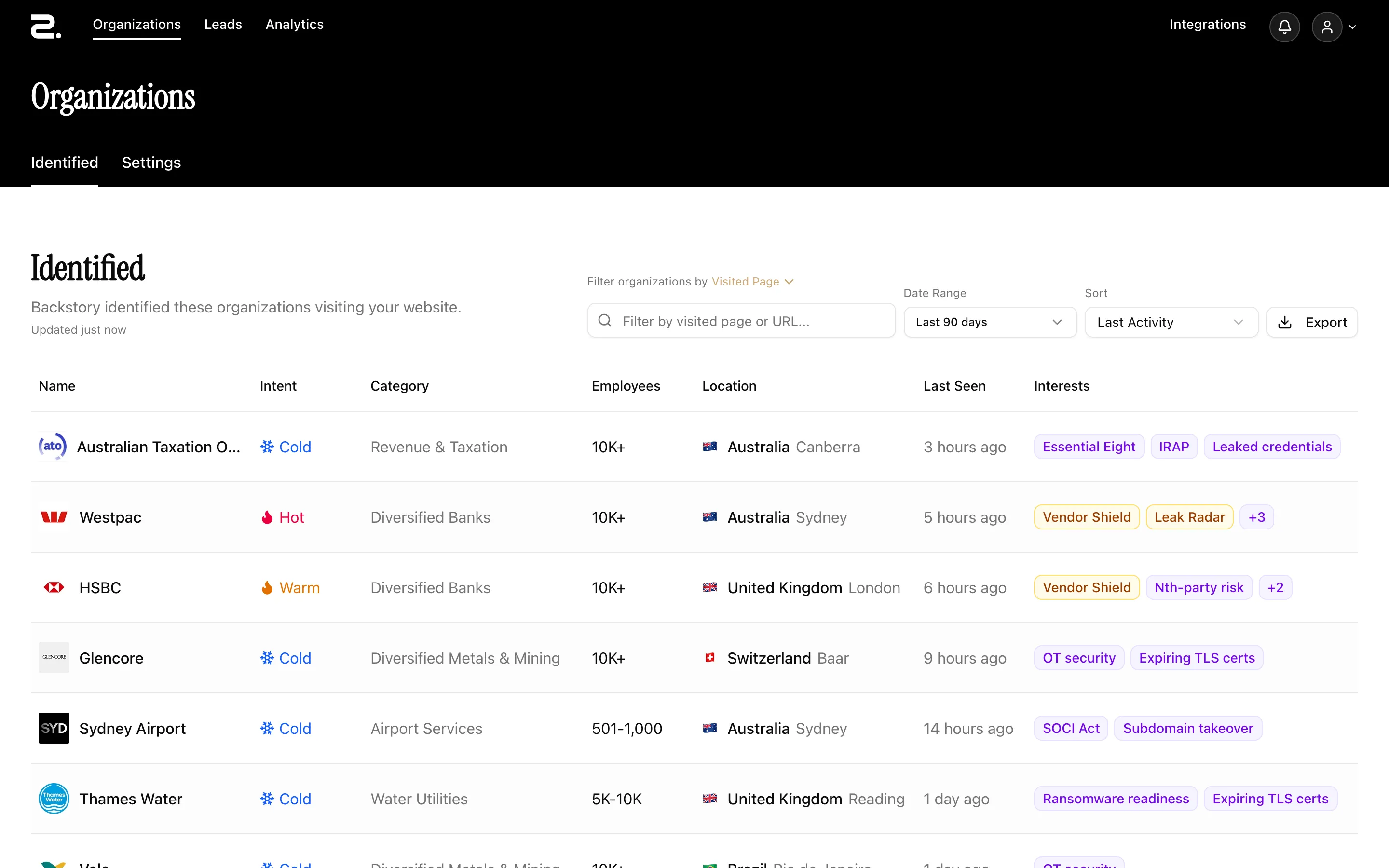
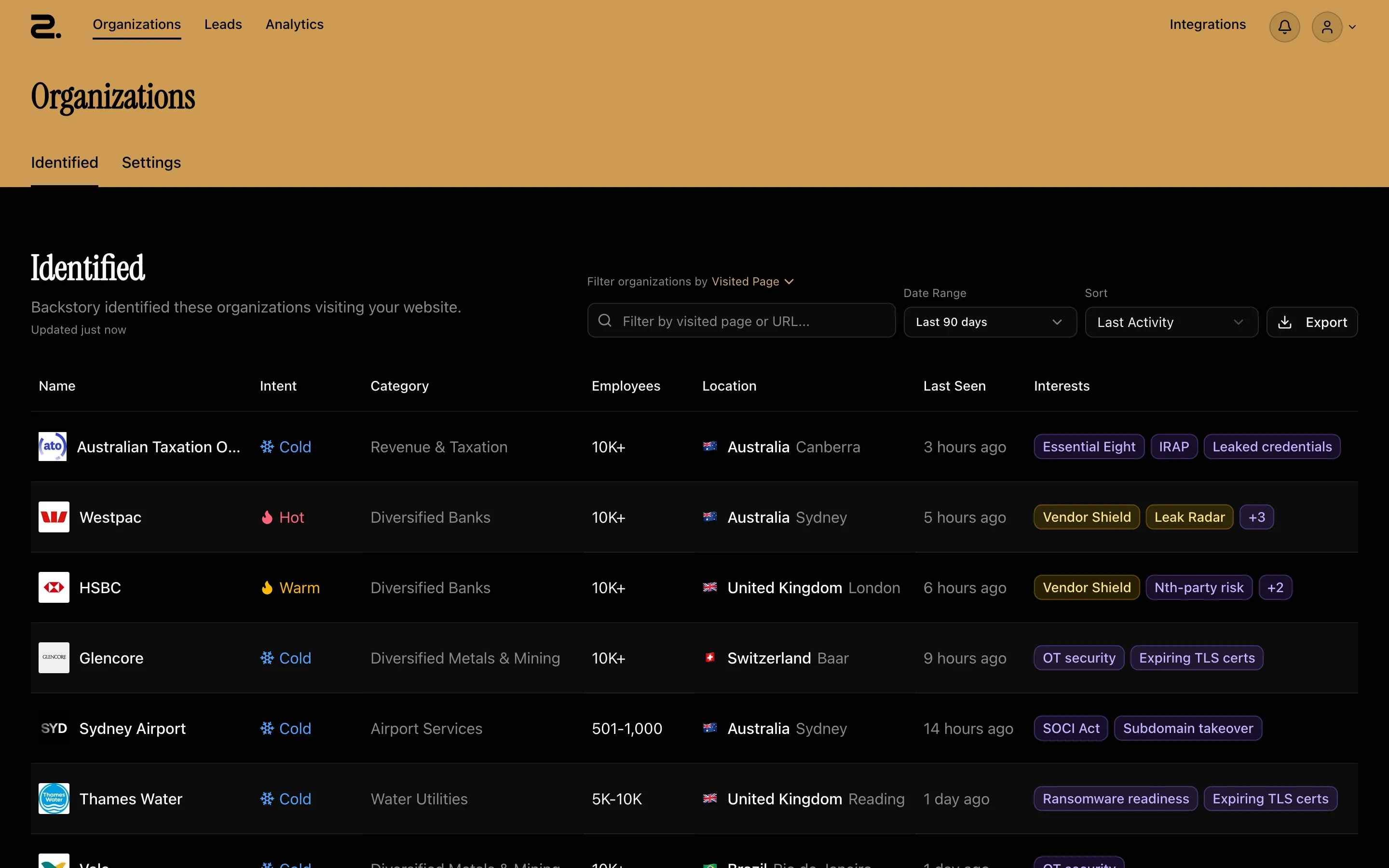
Other website visitor identification platforms trade quality for volume. Backstory filters out false positives from students, ISPs, SASE providers, SMBs and vendors trying to sell you something, so your sales efforts only go toward genuine enterprise buyers.
| Company | Last seen | Actions |
|---|---|---|
 | Live. | Needs chasing. |
 | Live. | Needs chasing. |
 | 1h ago. | New lead. |
 | 6m ago. | New lead. |
 | 22m ago. | New lead. |
 | 3h ago. | New lead. |
| Name | Intent | Interests |
|---|---|---|
 | Hot. | Critical infrastructureRansomware readiness. |
 | Hot. | Credential leaksAPI reference. |
 | Warm. | RiskScoreOT security. |
 | Warm. | TrustLensRiskScore. |
 | Warm. | Essential EightSOCI Act. |
 | Warm. | OT security. |
Illustrative example. Logos and organization names are trademarks of their respective owners and no affiliation or endorsement is implied.
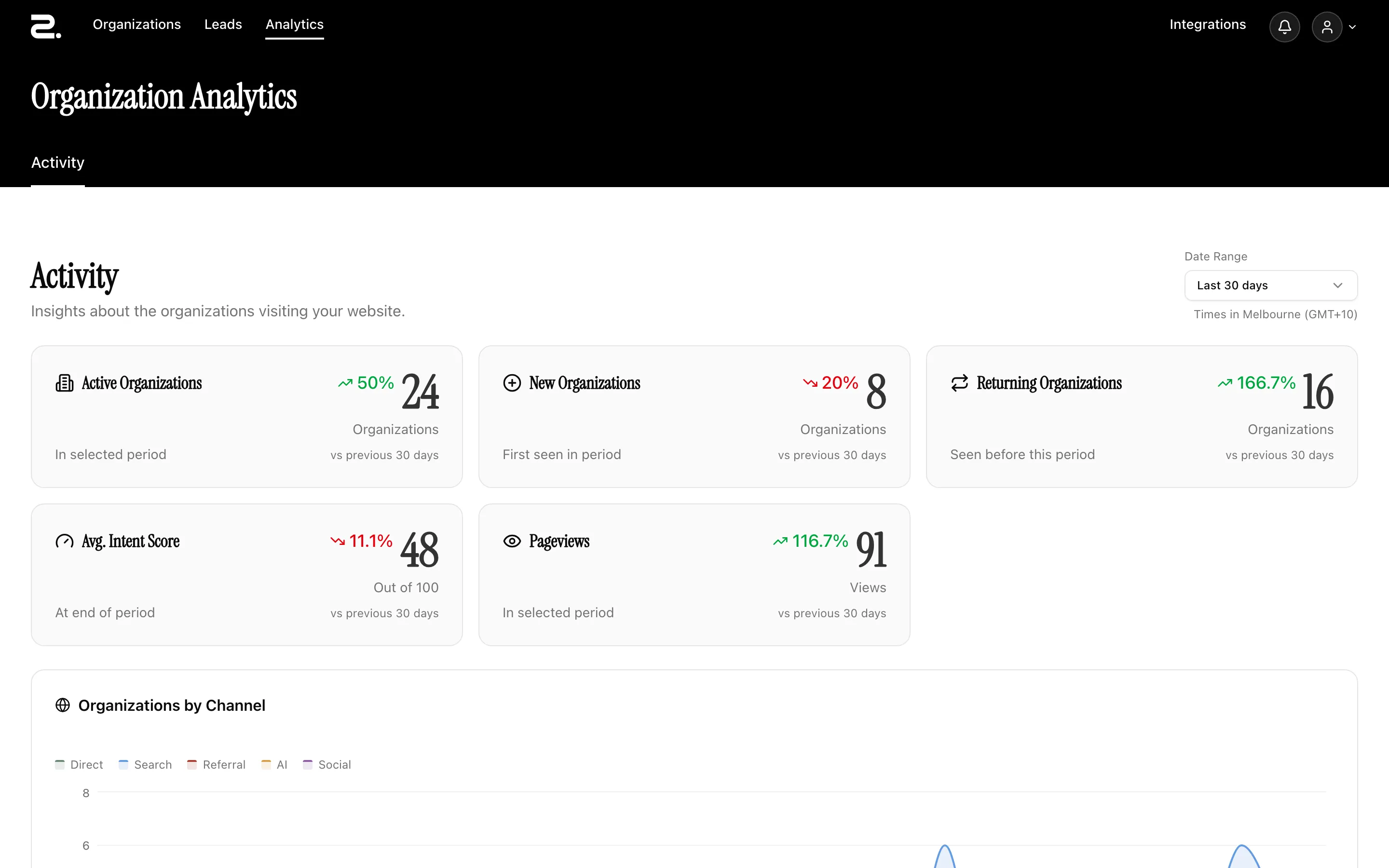
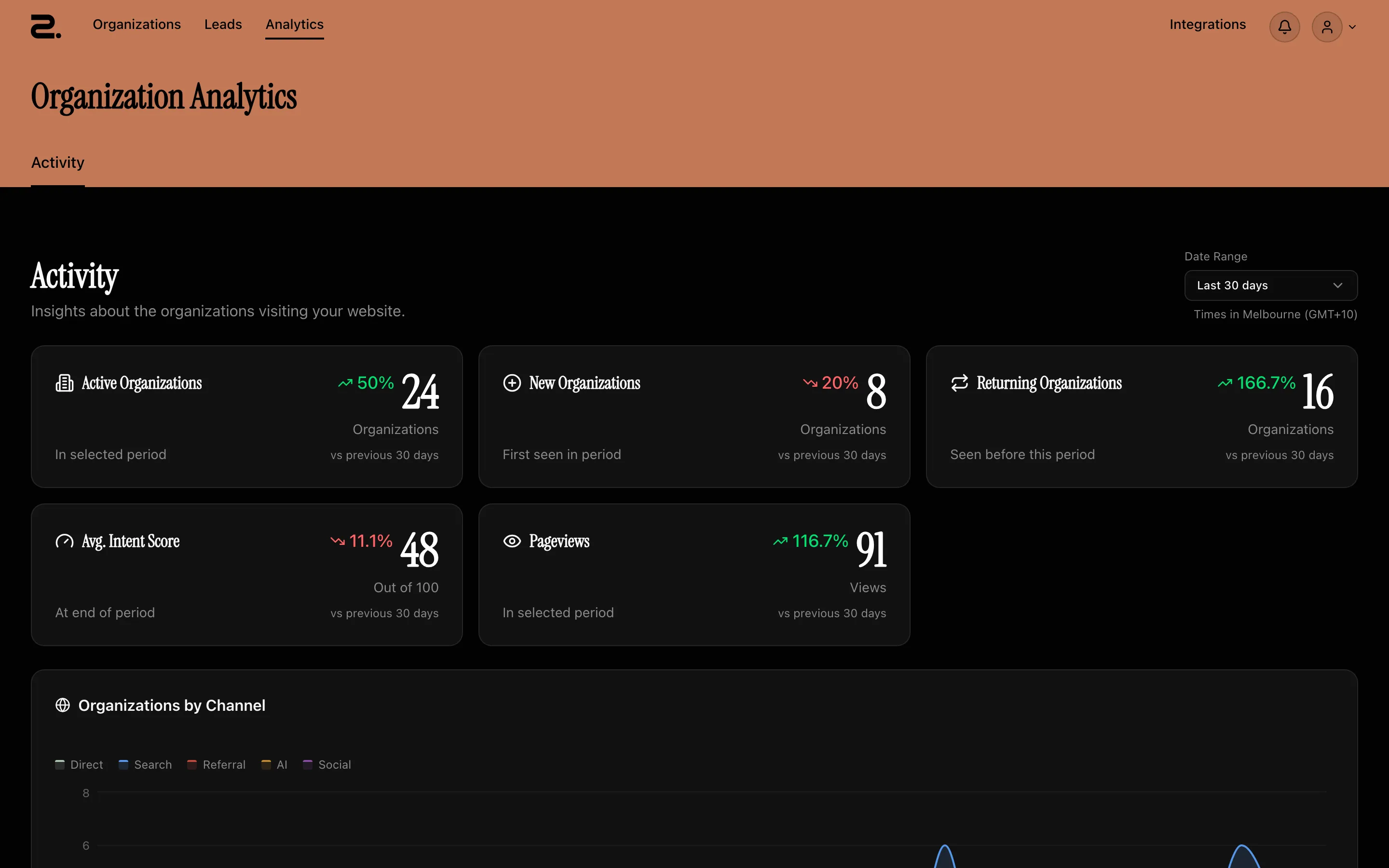
Know which marketing activities bring ideal customers to your website.
Stop optimising your marketing for students, spammers and bots. See which channels, paid ads and content are driving visits from real enterprise organizations.
How website visitor identification works
Four steps: identify the organization, understand what it read, score whether it’s worth pursuing, then find the people to contact there.
See which organizations are visiting your website
A first-party script resolves each visit to the organization behind it — no cookies, nothing stored on the visitor’s device, and never the individual who browsed.
- Filters out ISPs & home broadband, VPNs & proxies, cloud/datacenter hosting, and schools — the traffic that mislabels who’s really visiting.
- A three-tier filter: a curated blocklist of ~200 known providers, then pattern rules, then Claude AI for the edge cases.
- Smart enough to tell an employee from a server — it keeps microsoft.com, but drops azure.microsoft.com.
- When a network genuinely can’t be resolved to one organization — a shared corporate gateway, a SASE egress — Backstory says so instead of guessing.
- Companies, government agencies and public-sector bodies alike, each enriched with 50+ firmographic fields, the full set available on export.
Understand what they’re interested in
Backstory reads the pages each organization actually opened and tags what they engaged with — so a rep knows how to open the conversation instead of guessing.
- Your named products & services first — the specific offerings they read about on your site.
- Then the topics they care about — pulled from the pages they actually read, not a generic market taxonomy.
- A full buyer-journey timeline: every page, in order, across every visit from that organization.
- Grounded in your content, so outreach lands specific rather than boilerplate.
Know which organizations are worth pursuing
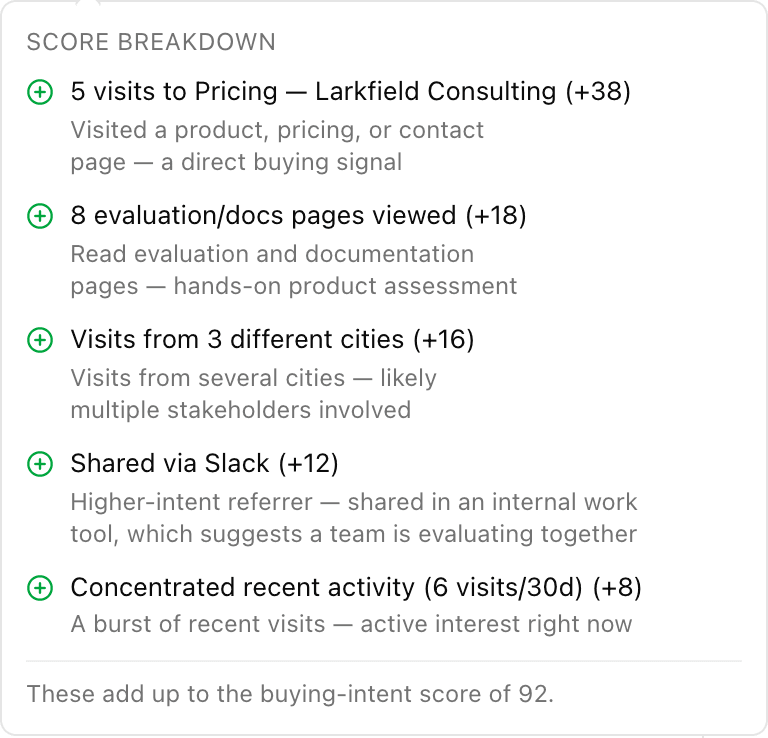
A transparent 0–100 buying-intent score, tiered hot / warm / cold, built only from what each organization did on your own site.
- The factors add up to the number. Exactly. No black box, and no bought third-party signal.
- Rewards buying signals, not browsing — pricing and demo visits, return trips, activity bursts, and multi-stakeholder traffic lift the score; blog volume doesn’t.
- Sort and filter by score and tier, so reps work the top of the list first.
- An AI writes the narrative around the score. It never sets the score.
Find the right people to contact
Tell Backstory the job titles you sell to. For any identified organization it counts the people who work at that organization and match them — free — and you spend a credit only on the ones you want.
- Set your target titles once: CISO, Head of Security Engineering, Director of GRC.
- See how many people match at that organization, scoped to the countries its visits came from, before spending anything.
- Spend a credit for a name, job title, LinkedIn profile, and a business email where one is available, labelled with its verification status.
- Sourced from a business-contact database — never from anyone’s browsing, and never the individual who visited your site.
- Included on every plan, with a monthly allowance and one flat rate beyond it.
- Target the titles you sell toCISO · Head of Security Engineering · Director of GRC
- 4 people match at this organizationCounted free, before you spend anything
- Spend 1 creditName, title, LinkedIn profile, business email where available
A plan for the ones worth pursuing
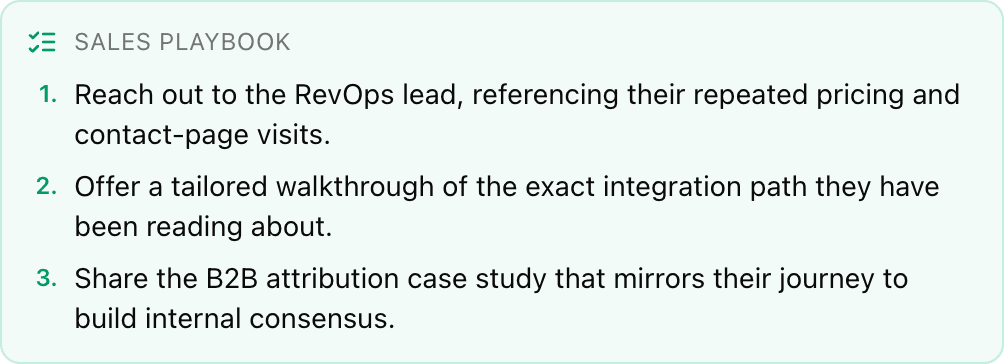
Every identified organization also gets a written brief: where it is in the buying journey, what it read, and specific next steps drawn from its real activity. Routed to Slack, or to any tool via webhook — Zapier, Make, n8n.
Buying signal without the privacy liability
Most visitor-identification tools de-anonymize individuals. Backstory identifies the organization, never the person who visited.
Organization-level identification, not person-level
We identify the organization from first-party behavior — the organization, never the individual who visited.
No cookies, no consent banner
Cookieless by design — nothing for your visitors to accept, nothing for you to manage.
No PII to identify the organization
Identification never de-anonymizes the person who browsed.
Private by architecture, not by policy
Organization-level and cookieless from the ground up — not bolted on after the fact.
Website visitor identification: your questions, answered
What is account intelligence?
Account intelligence is knowing which organizations are engaging with you, what they are interested in, which are worth pursuing, and who to contact at them. Backstory builds it from your own website traffic — first-party, cookieless, and at the organization level rather than by tracking individuals.
What is website visitor identification?
Website visitor identification resolves the anonymous organizations on your site into named ones. Backstory does it from first-party signals — no cookies, no tracking of the individual visitor — then scores each organization’s buying intent so you know which are actually worth your time.
Is account intelligence the same as website visitor identification?
Website visitor identification is one part of account intelligence. Identification tells you which organization is on your site. Account intelligence adds the rest: what they read, a buying-intent score that says whether they are worth pursuing, and the people to contact at that organization.
Why is this built for cybersecurity companies?
Enterprise security buyers research from corporate networks, in long committee-driven evaluations, and rarely fill in a form. That is exactly the traffic organization-level identification resolves well — and exactly the buyer a form-first funnel never sees.
Is it organization-level or person-level?
Organization-level — Backstory identifies the organization, never the individual who browsed.
Do you identify individual visitors?
No. Identification is organization-level and uses no PII: the individual who browsed is never identified. Separately, and only when you choose to spend a credit, Backstory finds people who work at that organization in the job titles you target — from a business-contact database, not from anyone’s browsing.
How is this different from Leadfeeder or third-party intent tools?
Third-party tools infer intent from activity across the web and hand you person-level data. Backstory scores what organizations did on your own site — first-party and explainable, the signals sum to the score. Different signal, and you never track the individual visitor.
Selling to a specific segment? Website visitor identification for cybersecurity vendors.
See who’s on your site.
Add one snippet and start identifying the organizations already on your site — what they’re reading, which are worth pursuing, and who to contact at them.